Houthis Claim Strike on Saudi Refinery as Iran Threatens Harsher Response to Further US Attacks
Yemen's Houthis say they hit Saudi Arabia's largest oil refinery at Ras Tanura, while Iranian officials warn of a more devastating reply to any new US-Israeli attacks.
By Ayanda Novak ·
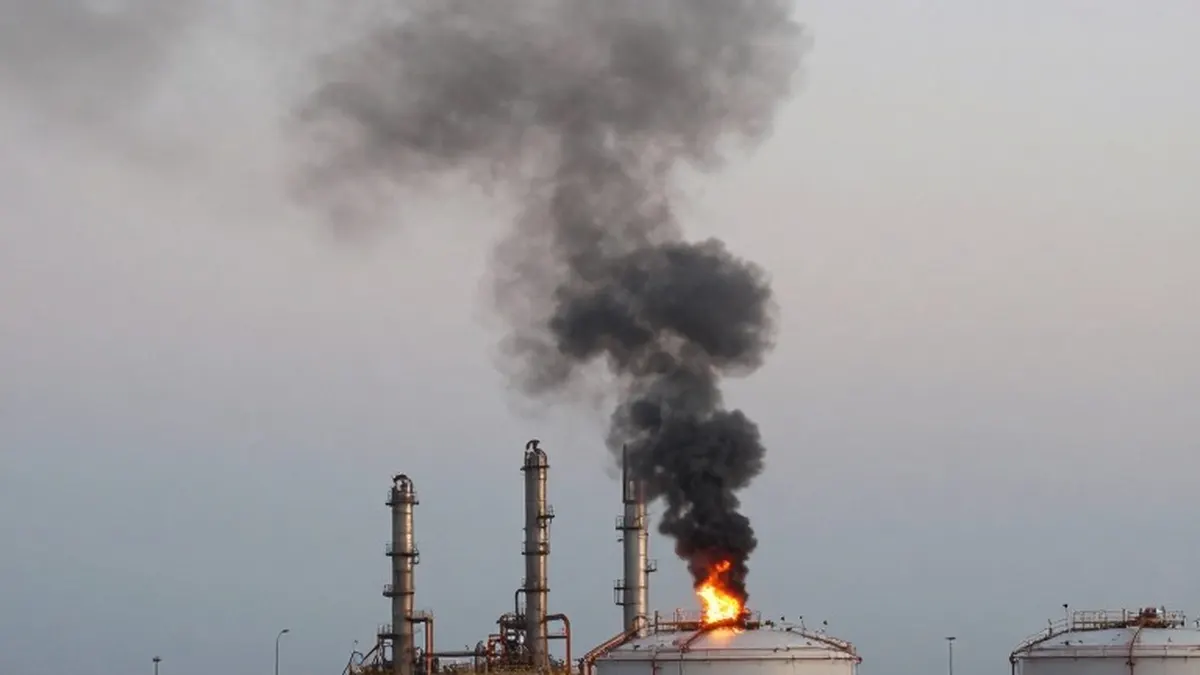
Yemen's Houthi movement, which calls itself Ansar Allah, said on Tuesday that it had struck Ras Tanura, Saudi Arabia's largest oil refinery. Saudi authorities have not confirmed the claim.
The group's military spokesperson, Yahya Saree, said a ballistic missile started a fire at the facility on the Gulf coast, west of the Strait of Hormuz. Bloomberg News, citing a source familiar with the matter, reported that Saudi Arabia had brought under control a fire near the Ras Tanura oil terminal earlier the same day.
The Houthis have stepped up attacks on Saudi territory since Riyadh bombed Sanaa's international airport in July. That raid ended a ceasefire and opened another front in the wider US-Israeli war on Iran. Saudi Arabia ships almost all of its oil exports through two main ports, Ras Tanura on the Gulf and Yanbu on the Red Sea. The Houthis have attacked Yanbu in the past.
Separately, Saudi-backed Yemeni forces said they had carried out 1,276 operations against Houthi positions over the previous 24 hours as part of their "Dawn of Yemen" offensive. Spokesperson Colonel Majed al-Nuzaili said about 382 Houthi commanders and fighters had been "neutralised", without saying how many were killed or wounded. He added that 140 military vehicles and heavy weapons were destroyed or damaged, along with several arms and ammunition depots, and that command centres, defensive positions, reinforcements and supply routes were hit on multiple fronts.
The US Embassy in Riyadh has told non-emergency government employees and their families to leave Saudi Arabia because of safety risks, an order first issued on 23 October. In a post on X, it warned of possible further attacks on airports, airspace closures, flight cancellations and travel disruption.
In Tehran, state media reported that Mohsen Rezaei, secretary of the Supreme National Security Council, met Supreme Leader Ayatollah Mojtaba Khamenei on Tuesday. Khamenei has not appeared in public since succeeding his father, Ali Khamenei, who was assassinated by Israeli and US forces on 28 February. The meeting followed Monday talks between Rezaei and members of the Mecca Alliance: Saudi Defence Minister Prince Khalid bin Salman, Pakistan's army chief Asim Munir and Turkey's intelligence chief Ibrahim Kalin. Regional states are seeking an end to the war. "Washington's inability to provide security guarantees has become evident," Rezaei wrote on X, adding that security in West Asia must come from within the region.
Abdollah Haji Sadeghi, the supreme leader's representative to the Islamic Revolutionary Guard Corps, said Iran knew "the enemy's vulnerabilities" and that further US attacks would bring a "harsher and more devastating" response, according to the semi-official Tasnim news agency. He said the enemy had wrongly assumed that killing Iranian leaders and commanders would turn the public against the government, and was now turning to psychological warfare.
In the United States, President Donald Trump defended the war on Monday at a campaign rally in Corinth, Mississippi, as polls show him struggling ahead of elections that could cost Republicans control of both houses of Congress. He repeated a Republican lawmaker's false claim that Iran started the war, said he had expected oil prices to rise much higher, and called an earlier ceasefire "a waste of time". He also said Iran had developed missiles able to reach Europe and potentially US cities.
Speaking in Cambridge during a visit to the UK, Omani Foreign Minister Badr al-Busaidi urged Gulf states to form a non-aggression pact with Iran and move away from a failed US security umbrella. He said an unstable regional system had been built on the "entirely false perception" of a fundamental antagonism between Iran and the Gulf Arab states, noting that Arabs and Persians have lived in peace around the Gulf for centuries.
Source: Middle East Eye