Election Denial Moves Into Positions of Power as U.S. Midterms Approach
Local clerks, sheriffs and advocacy groups are preparing for possible interference as officials who embrace unproven fraud claims gain authority ahead of the 2026 midterms.
By Riya Conti ·
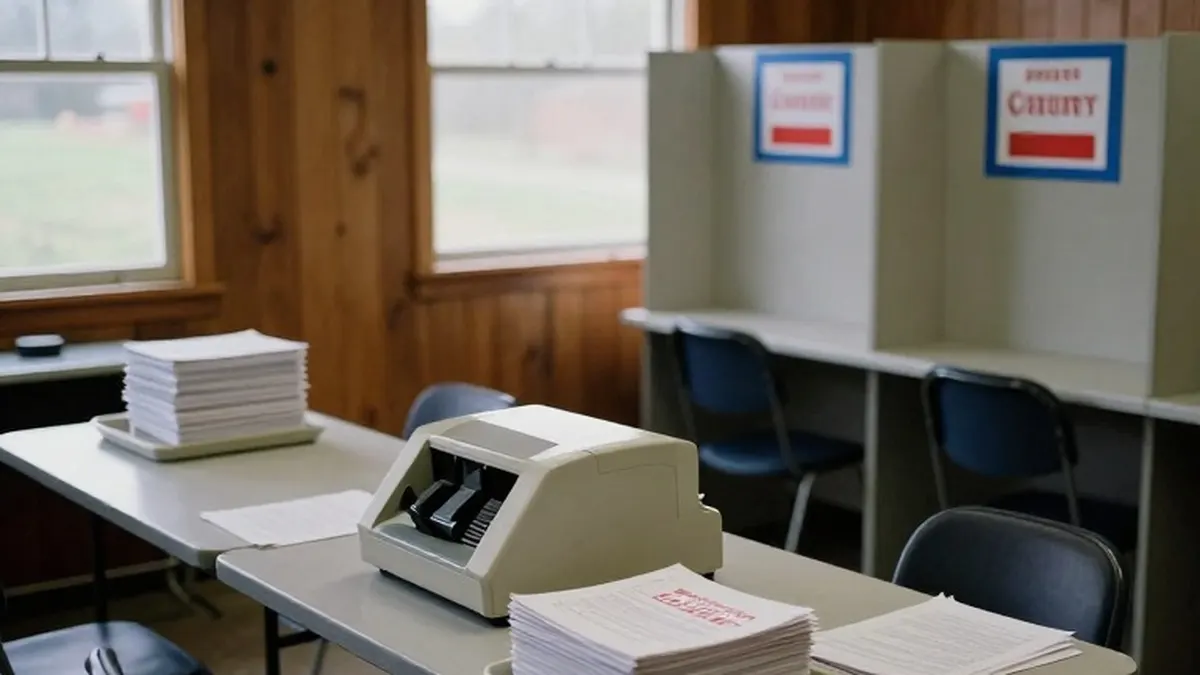
In Barry County, Michigan, a dozen people gathered in a wood-panelled room one October morning to train as poll workers for the U.S. midterm elections. Over three hours, they learned to run a vote-tabulating machine, check photo IDs and process absentee ballots. Before the session started, county clerk Sarah VanDenburg thanked them for "helping preserve our democracy."
The 2026 midterms are unfolding while an election denial movement, empowered by President Donald Trump, has spent months portraying such routine tasks as the source of rampant fraud. There is little evidence for the claims, but they are being used as a pretext by deniers, many now in positions of authority, to try to interfere in voting. Trump has also mused openly about invoking a national emergency measure to change how votes are counted.
In Barry County, Sheriff Dar Leaf has become a leading voice for election conspiracies. For six years he has circulated claims that foreign nationals hacked county voting machines in 2020 to switch votes from Trump to Joe Biden. He is now trying to question state election officials as part of an investigation into allegations that Michigan's 2026 voter rolls are being inflated with non-citizens, even though studies show non-citizen voting is extremely rare. "I have a duty to go out and investigate, and I'm not gonna back down," Leaf told CBC News. VanDenburg says she keeps a good working relationship with him, but his beliefs "can make things difficult."
Leaf is prominent in the Constitutional Sheriffs and Peace Officers Association, which holds that sheriffs have ultimate authority in their counties. In 2021 and 2022 he and his deputies tried to seize several voting machines, but a judge and a prosecutor found his claims had no merit. Last year, California sheriff Chad Bianco, another member of the group, seized 650,000 ballots from the 2024 election, and a court ruled the seizure unlawful and ordered them returned. Asked whether he would seize ballots, Leaf said he would need a good reason and would probably seize them and then obtain a court order.
Federal institutions are also involved. Election deniers now hold senior posts at the Department of Justice, which is fighting 30 states for access to sensitive voter information in a search for evidence of non-citizen voting. Earlier this year the FBI seized 2020 ballots in Fulton County, Georgia, even though the state's results were counted three times, each affirming Biden's win. The FBI and ICE have been tasked with investigating voter fraud, which most studies suggest is rare.
Trump has ordered the U.S. Postal Service to restrict mail-in voting and pushed Congress to pass a voter ID law that would have made it harder for millions of Americans to vote. The Constitution gives states, not the president, authority over elections, and courts have so far upheld that principle.
With those efforts stalled and polls suggesting Republican congressional majorities are at risk, some in the movement are urging a national emergency declaration, arguing that voting machines are vulnerable to foreign hacking. Asked about it by Time magazine, Trump said, "I don't rule anything out or in." Detroit pastor Lorenzo Sewell, who has ties to the administration, said such a move could let the president halt machine counting and mail-in balloting, adding that it would need public pressure, "another January 6th," in his words, "minus the violence." Legal experts widely call the idea unconstitutional. David Becker, a former Justice Department elections lawyer who now leads the Center for Election Innovation and Research, said the Constitution is built on the idea that the president has no power over elections.
Voting-rights groups and state lawmakers are preparing for scenarios that include confrontations with armed federal agents or pro-Trump crowds. Autumn Butler of Michigan United, which trains "democracy defenders" in de-escalation, said the rhetoric "has become more violent." She recalled a 2020 crowd of Trump supporters trying to disrupt poll workers counting mail-in ballots in Detroit.
VanDenburg is hoping her own preparations will keep tensions down. She recently briefed the sheriff and his deputies on basic election day rules, including that armed officers are not allowed in polling stations. Leaf welcomed it, saying some of the information was something "we've never been taught before." She expects most poll workers to be local residents, which she says will keep the mood warm and welcoming for voters.
Source: CBC News