Nine-Hour Groundings: How Drone Raids Are Reshaping Moscow Air Travel
Intensified Ukrainian drone activity has forced major Russian hubs to suspend operations for extended periods, prompting experts to question the long-term viability of international air travel to the region.
By Riya Conti ·
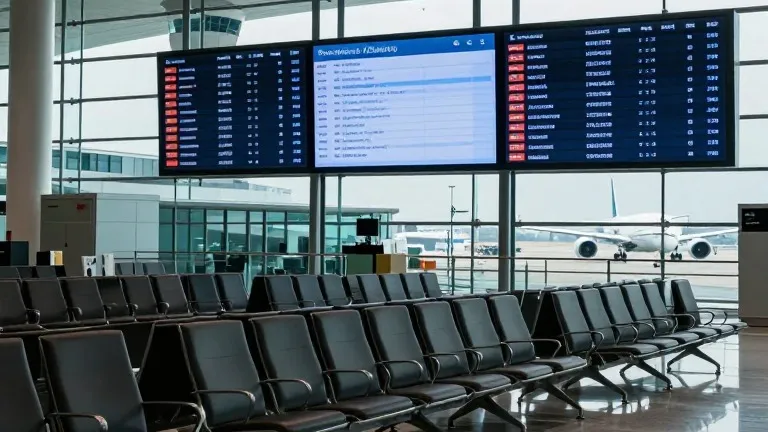
Flights at Moscow's primary aviation hubs have been suspended for as long as nine hours on several days this month, marking a sharp escalation in the disruption caused by Ukrainian drone strikes. This level of ground time represents a significant intensification compared to the previous months of the conflict. The operational halt has affected Domodedovo, Sheremetyevo, Zhukovsky, and Vnukovo airports, which have faced near-daily suspensions according to data from the independent investigative group Agentstvo. For global travelers and logistics firms, this volatility is beginning to translate into tangible financial costs and schedule uncertainties.
The current campaign aligns with a strategic objective outlined by President Volodymyr Zelenskyy in early September. He declared an intent to make Russian airspace around Moscow and other key destinations effectively unusable for commercial traffic. Addressing the aviation sector, insurers, and passengers, Zelenskyy asserted that the skies over Russia would become entirely unsafe. The following day, Kyiv formally communicated this warning to the International Civil Aviation Organization, signaling that the disruption is a coordinated military and economic strategy rather than an isolated incident.
The immediate cause of the closures lies in a specific safety protocol administered by Rosaviatsiya, Russia's aviation authority. Referred to as the "carpet" protocol, this measure mandates the immediate closure of airspace over a region or around specific airports if an aircraft breaches boundaries, weapons are deployed, or unidentified objects appear. Oleksandr Laneckij, chief executive of the consultancy Friendly Avia Support, notes that under this framework, every drone is treated as a military threat. He draws a parallel to the disruption caused by Yemen's Houthis in Saudi airspace, noting that Ukraine's military capabilities significantly exceed those of the Houthis, suggesting the impact could be even more profound.
Military analyst Jan Matvejev argues that severely disrupting air traffic around the Russian capital is achievable for Ukraine without a full closure of all airspace. He points out that triggering the protective protocol requires only simple, non-warhead drones with limited range. With Ukraine's domestic industry capable of producing hundreds of combat-ready long-range drones daily, the supply side is not a constraint. Simon Shuster, writing for The Atlantic in October, cited well-informed sources to suggest that these efforts are merely in their initial stages, implying further escalation is likely.
Experts also highlight the limitations of Russian air defenses in this context. Matvejev suggests that if current systems were fully effective, the drones would have been neutralized by now. He argues that Russia would have deployed additional air-defense units if they had sufficient reserves. This perceived gap in defensive capability creates an ongoing risk for civilian aviation, as the threshold for declaring a threat may be lowered, increasing the frequency of these costly suspensions.
The safety implications for passengers are a major concern for industry observers. Laneckij warns that the risk of deadly incidents similar to the Christmas Day 2024 crash of an Azerbaijan Airlines flight is rising. Investigators determined that aircraft was struck by a Russian air-defense missile intended to counter drones, resulting in 38 fatalities. Matvejev notes that little has changed in the defensive protocol since that tragedy. While low-flying drones shot down with machine guns pose minimal risk to airliners, the use of missiles introduces a different variable. Defects in mass-produced missiles could potentially send them toward nearby commercial aircraft, a risk that is difficult to eliminate entirely.
Beyond missiles, the physical mass of the drones themselves presents a hazard. Matvejev explains that drones traveling from Ukraine to Moscow are large enough to weigh dozens of kilograms, meaning a simple collision can be catastrophic even without explosives. This trend is not limited to the capital. Ukrainian forces previously targeted Pskov airport in the summer of 2023, and debris from drone strikes has recently fallen on Sochi airport. Conversely, Russia has also struck Ukrainian aviation infrastructure, with Kyiv's airport and Boryspil being hit in September.
The financial future of foreign airlines operating in Russia will hinge on three key variables: the intensity of the military threat, passenger demand, and insurance premiums. Laneckij states that if insurers classify the risk as very high, they will likely raise premiums significantly, which will drive ticket prices up. The competitive landscape in Russian aviation has already contracted, as many carriers have ceased operations. This has increased demand for seats on the remaining foreign airlines. Ultimately, the decision for these carriers to continue flying will depend on the price they must pay to mitigate the dangers of the current airspace environment.
As the October disruptions continue, the aviation industry faces a complex balancing act. The combination of frequent groundings, potential safety risks from air-defense engagements, and rising insurance costs is reshaping the economics of travel to and from Russia. For now, the pattern of near-daily suspensions at Moscow's major airports signals a new, more volatile era for the region's air transport network.
Source: Deutsche Welle
More Business · World news · Rip-Off Report · Report a business · Got a Story?