Resilience in Kyiv as Winter Looms Over a War-Weary Capital
As infrastructure failures and deadly strikes reshape daily life, the capital's residents brace for a challenging season while maintaining a strong commitment to holding their ground.
By Samir Lin ·
For millions of inhabitants in Ukraine's capital, the familiar rhythm of daily existence has fundamentally shifted over the past several months. What was once a relative calm compared to the intense fighting in other regions has given way to a reality that mirrors the conditions on the active front lines. This transformation is not merely a matter of perception; it is a tangible change in how people navigate their homes, workplaces, and public spaces as the conflict deepens its impact on the city center.
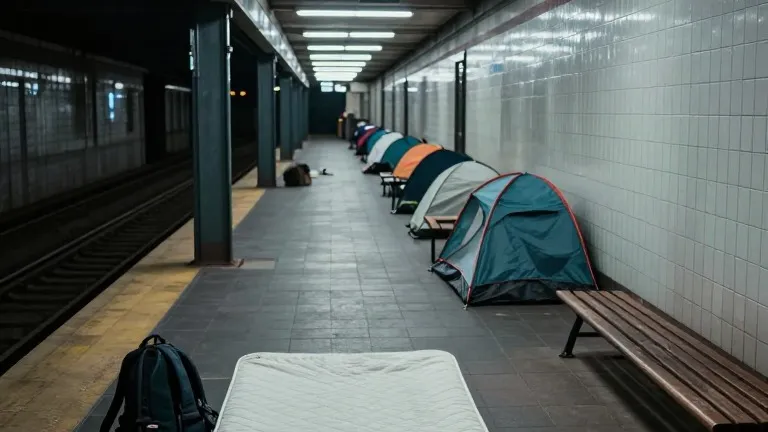
The scarcity of adequate protective spaces has forced a significant portion of the population to seek refuge in underground infrastructure. With insufficient designated shelters for the four million residents, subway stations have effectively become temporary residential hubs. Every night, starting around 10 p.m., individuals lay out bedding and erect small tents within these stations. Families, including young children and pets, settle along the cold walls, creating a communal atmosphere of survival in the dark. Halyna, a resident of the frequently targeted Lukyanivka district, described the routine of taking her five-year-old son to these stations even without a siren, noting that they have simply been fortunate to survive another night.
The human cost of these intensified attacks is starkly visible in the loss of young lives and the disruption of educational settings. In September, a drone strike on an apartment building in the Pechersk district killed fourteen-year-old Daniel Umanskyj while he was doing homework. The tragedy has left a mark on the neighborhood, with flowers now displayed in memory of the boy. Similar incidents have targeted schools, including a drone hit in early October on a building in the southwest. Despite the danger, many schools continue to operate in person, relying on large internal shelters that can accommodate hundreds of students. However, attendance remains precarious, dependent on the duration of air alerts and the availability of safe spaces, leaving parents to balance work responsibilities with the risk of their children being alone at home.
Logistical challenges are compounding the immediate dangers. Attacks on storage facilities have led to supermarket shortages comparable to those seen in the early stages of the full-scale invasion. Furthermore, emergency power cuts that began in late September and a subway outage caused by a recent strike highlight the vulnerability of the city's essential services. As winter approaches, questions remain about the reliability of heating, electricity, and water supplies, adding a layer of uncertainty to the already difficult living conditions.
Statistical data underscores the severity of the situation. The military administration reports that 140 people have been killed in the capital during the first eight months of 2026, a figure that already exceeds the 172 deaths recorded for the entirety of 2025. If this trajectory continues, the current year may become the most lethal for the city since the invasion began in 2022.
Despite these pressures, social surveys indicate a enduring resolve among the populace. A study by the Kyiv International Institute of Sociology conducted in September found that 72 percent of residents are prepared to endure the conflict for as long as required. Local authorities are working to maintain a sense of normalcy by adjusting curfew times and allowing certain facilities to operate during lower-level threat alerts. Yet, when red alerts signal potential ballistic or cruise missile threats, the imperative to shelter immediately remains the overriding priority for all citizens.
The evolving nature of the conflict in Kyiv suggests that the capital will continue to face significant challenges in the coming months. The combination of infrastructure strain, high casualty rates, and the psychological burden on families creates a complex landscape. As the city adapts to these new realities, the focus remains on maintaining essential services and supporting the resilience of its residents through the winter season.
Source: Deutsche Welle