
3 Billion Miles Away: Halley's Comet Debris Creates 3 Meteor Streaks in Georgia
A recent photograph captures three distinct meteors from the Orionid shower, a phenomenon driven by particles left behind by a comet currently billions of miles from Earth.
By Samir Lin ·
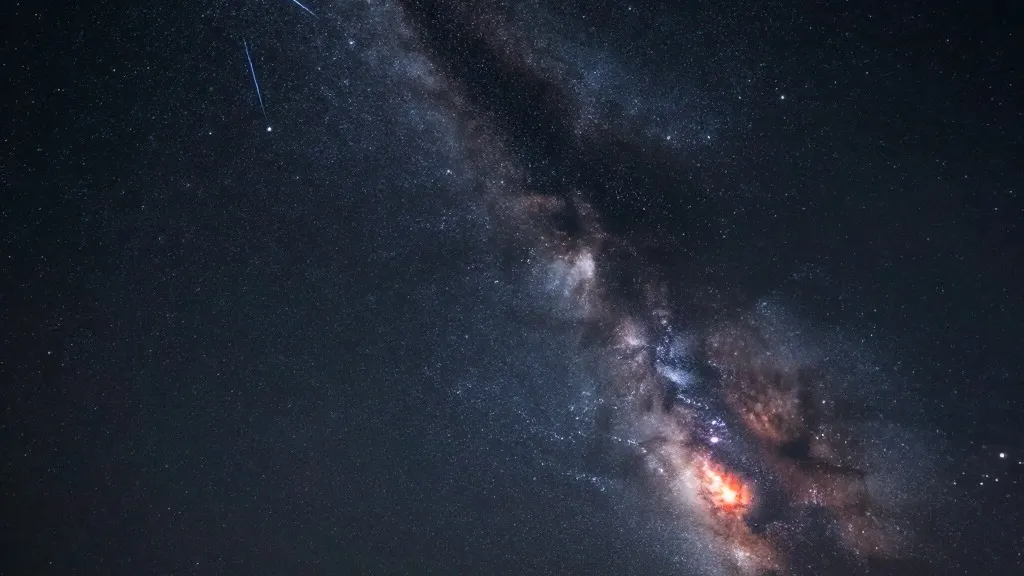
Three distinct meteor streaks were captured in a single astrophotograph taken over Toccoa, Georgia, on October 21. The image, recorded by photographer Tim McCollum, documents the annual Orionid meteor shower as it approaches its peak activity. This visual record highlights the ongoing presence of cosmic debris in the Earth's upper atmosphere, even when the source comet is far removed from our immediate vicinity.
The glowing trails are fragments of Comet 1P/Halley, also known as Halley's Comet. Although the comet itself is currently situated more than 3 billion miles from Earth, the particles it shed over millennia continue to intersect with our orbit. This interaction creates the visible meteors seen during the autumn season. The photograph shows each meteor appearing to radiate from a specific point in the sky, a phenomenon known as the radiant.
For observers in the Northern Hemisphere, this radiant point lies near Betelgeuse, a prominent red giant star within the constellation Orion. McCollum recorded the events between 3 a.m. and 4 a.m. on October 21. Capturing such fleeting events requires a combination of technical skill, patience, and fortunate timing. The photographer utilized a Canon EOS Ra camera paired with an RF 28-70 f2.0 lens. A star tracker was employed to keep the camera aligned with the radiant, while multiple 30-second exposures were merged using PixInsight software to create the final composite.
The image contains more than just the meteor trails. The background features the stars of Orion's Belt situated on the right side, close to the luminous Orion Nebula. This nebula is one of the major star-forming regions nearest to Earth. Additionally, the Rosette Nebula, identified as Caldwell 49, is visible within the dense starfields and dust lanes of the Milky Way's galactic plane. The galactic plane runs diagonally across the composite, offering a rich backdrop of numerous star clusters.
The current meteor shower is expected to remain active until November 7, providing skywatchers with additional opportunities to observe these phenomena. The coming nights offer a window for further sightings of debris from Halley's Comet. Observers should be aware that the shower's activity levels will fluctuate, but the period leading up to the peak provides the best chances for visibility.
There is an additional element of interest for those monitoring the night sky during this period. Earth is currently passing through debris streams associated with Comet 2P/Encke. These streams are responsible for the Taurid meteor shower. The intersection of these two debris fields can occasionally result in the appearance of bright fireballs, often referred to as Halloween Fireballs due to their timing around the end of October.
As the global community continues to track these celestial events, the intersection of Halley's Comet debris and the Taurid stream offers a unique astronomical display. The longevity of the particle trails from Halley's Comet serves as a reminder of the dynamic nature of our solar system. The current activity provides a clear example of how distant objects continue to influence the visual experience of the night sky on Earth.
Source: Space.com